Category: Product Technology

  • How Business Leaders in Logistics Can Improve Efficiency and Results

    How Business Leaders in Logistics Can Improve Efficiency and Results

    It’s a new year, which inevitably means change. Further, when it comes to the often-lagging logistics industry, change can be a very good thing.

    Soon, in fact, change may be crucial to survival — if it isn’t already. But, for today, we’re sharing some insights into how a particular (now common) form of change can help you improve efficiency and results, as you keep on shipping into the future.

    We’re talking about technology. Obviously we are fans of technology.

    As creators of the NEXT app, we believe in the power of tech to improve and speed up supply chain flow and maximize profit. If we didn’t believe this so strongly, we wouldn’t be here grinding into the new year, set on helping you bring tomorrow’s solutions to today’s steady demand for freight — and growing demands in e-commerce.

    But why should you turn your tried-and-true systems of work over to new technologies?

    We’re glad you (we) asked that.

    Here are some lessons we’ve researched and absorbed, from companies across industries.


    1. It’s about speed.

    Remember Kodak? They’re still around, but it’s been a long time since the brand was associated with its once-dominant market position in photography.

    In 1976, Kodak was responsible for up to 85% of camera sales and 90% of film sales in the US. By 2010, their market share for cameras had shrunk to 7%, largely due to the company’s failure to shift to digital cameras, which they invented — and then shelved in 1975, out of fear of eating into film sales. So, instead of transitioning their own revenue to a new product line, competitors ate steadily into their market share instead.

    You may think that logistics and photography are two different beasts, but consider that the failure of Kodak to adapt to changes in an industry they helped create, not to mention their active resistance to the sort of technological innovation that is rarely, if ever, stopped.

    Here’s the silver lining — despite these steep drop-offs in their core business areas, Kodak survived bankruptcy, by re-organizing and rebranding themselves as a technology company.

    Shippers, fleet managers, and owner operators who embrace the change (and speed) of new technologies (like the NEXT Trucking app) can avoid making a business mistake like Kodak’s.

    Technology often (always?) moves on, faster than before, whether we accept it or not. Some of today’s smartest business leaders acknowledge this, and take advantage of the change to increase capacity and demand, explore new opportunities, and adapt to an ever-shifting market.

    Is it smart to test new technologies first, and to do your homework before adopting them across the board? Certainly. But this still requires that you start, and that you continue to observe your markets closely enough to ensure you aren’t allowing yourself to fall behind, if you’re slow to adopt.


    2. It’s also about quality.

    Okay, last example about cameras, we promise (although NEXT does ship a lot of electronics).

    Consider an opposite example from Kodak.

    Arri is a motion picture film equipment manufacturer that opened for business in Germany over 100 years ago.

    Guess which company sells one of the single most popular digital film cameras in use by Hollywood and filmmakers all over the world, today?

    It’s Arri.

    Known for years as one of the top sellers of old-school, sprocket-loaded analog film cameras, Arri saw the writing on the wall and released its Alexa digital model in 2010, and the product quickly became an industry standard. Arri’s embrace of technology belies an acceptance on the part of leadership of the inevitability of change.

    The point is this — with technology, speed no longer has to come at a sacrifice to quality (more on this in a second). Not only was Arri’s strong reputation and significant market position maintained as it embraced tech and evolved as a company, it has grown since the triumph of the Alexa. Success is the best press.

    In logistics, as in nearly every industry these days, the imperative to reassess our previous or current ways of doing things is the same.

    Perhaps you’re not still depending on paper invoices, PODs, or BOLs — but are you leaning on an old computer system that’s expensive to maintain (in direct costs and lost productivity) and much slower than newer options available? Even if you are generally happy with it, are you sure your system is providing as much efficiency as possible? Is there an important task it helps you complete that you feel should be easier by now? Chances are, it has been made easier, through some new technological advancement.

    With a solution like the NEXT app, you can step immediately into the future, just like Arri did — often while integrating your current systems along the way. That increased ease? It gives you some of your time back, that you can use to grow.


    3. It’s about doing the impossible (delivering speed and quality, at reasonable cost).

    Or what used to be impossible.

    You might be familiar with the old adage in labor and customer service:

    You can have quality. You can have speed. You can save on cost. But you can only have two out of the three.

    We’d argue that this is changing, that now it is possible to get quality work done, quickly, at a cost that’s reasonable to business and, crucially, that’s repeatable and/or scalable to the point of increased profit.

    Here’s a much more familiar example of this type of success: Amazon.

    How did Amazon become the e-commerce behemoth it is today? Mostly, they did it by promising speed and convenience, at costs that consumers found attractive — including in terms of time saved, as an increasing number of items shipped straight to their home.

    Perhaps your business is already known for speed. It would stand to reason. Probably you’re just as proud of the quality service that you offer. Maybe your prices are even competitive.

    But when was the last time you took stock of your offerings, and asked yourself if your workflows could be improved?

    In today’s economy, even a 1% increase in profit, productivity, or sales volume, can make a world of difference, as you continue to engage opportunities and serve your clients and customers. And that 1% can have a compound effect, especially as you continue to try new things.


    4. It’s about tomorrow.

    By now, it has probably become clear to you that we have our eye on the future, and that we believe you should, too.

    Consider the pervasive shortage of quality, available truck drivers in our industry, which is not expected to end anytime soon.

    Do you want to be caught without a solution to this growing problem?

    We come from trucking stock, and, when we saw the world changing fast, we didn’t want our families, partners, and customers to buckle under the pressure of logistical challenges like this. That’s why we created NEXT, in the first place. We’ve said it before (even in this post), and we’ll say it over and over again.

    The future is coming. Be ready.


    5. It’s about results.

    We’ll leave you by repeating yet another old adage: Numbers don’t lie.

    How are you performing, against competitors? How are you handling the increased demand for e-commerce, the driver shortage, the new challenges introduced by the latest legislation?

    Are your operations optimized — to the fullest? Do your results show an understanding of what’s NEXT in trucking and logistics?

    It’s probably a good idea to find out. What better opportunity is there than the arrival of a new year? Good luck and best wishes in 2019!

  • Diversity and Inclusion at NEXT Trucking — Fundamental and Necessary to Growth

    Diversity and Inclusion at NEXT Trucking — Fundamental and Necessary to Growth

    At NEXT Trucking, we believe in the powers of diversity and inclusion.
    This is due as much to our core values as our commitment to taking part in a future accelerated and grown by technology. It’s why we’ve partnered with the Mayor of LA on the PledgeLA initiative, and it’s why we were recently recognized with a Stevie Award for women in business. NEXT Trucking was also named one of the Top Companies for Women to Work for in Transportation by Women in Trucking.

    But this commitment is not just about values and recognition — diversity is good for business.

    Here’s why:

    A diverse workforce brings a diversified talent set to your company and its business practices.

    Skills, expertise, experiences from a different perspective — all these things and more can combine to help your organization teach itself from the inside-out. This invariably translates to more growth and success for your business.

    Inclusion reduces fear of being seen as different, which optimizes performance.

    When a company creates an environment of inclusiveness, internally and in its public dealings, employees who may not fit the definition of the workforce or demographic majority — feel more comfortable and supported. This, in turn, greatly reduces the likelihood that such factors might slow down their growth and progress as individuals and contributors.

    It also keeps the door open for them to more freely share their own knowledge, which may come from a different perspective than others, adding to the likelihood of overall camaraderie and collaboration. Inclusion increases comfort across work groups and keeps up morale.

    Different language skills can open new opportunities.

    While language and cultural differences can sometimes cause a company some complications, once these are handled or worked through — entire new lines of business and communication can be opened, locally and globally.

    Beyond this, when clients (and prospective clients) across the world see themselves represented in your workforce, they’re more likely to feel comfortable and to relate to you. That is definitely an advantage to your sales funnel.


    Diversity introduces your business to more of the market.

    Arguments could be made that marketing and selling to various niches of consumers (including B2B buyers) has never been more work, or more fully doable with today’s technology. This being said, it nevertheless stands that you first need to intimately know — and be able to clearly communicate with — various niche groups, among your prospects and current customers or partners.

    When it comes to groups of consumers who come from different backgrounds, having members of those backgrounds within each wing of your operations — prepares you to more effectively recognize and pursue opportunities among them in your market.


    In conclusion, diversity wins.

    Don’t just take our word for it. The statistics don’t lie. When employees feel included, innovation increases by 83%. When a team is diverse, decision-making improves by 60%.

    And 35% of diverse companies (that’s us) outperform homogenous ones. Want to know more about how NEXT does it? Contact us.

  • 5 Free Apps To Improve Your Life On The Road

    5 Free Apps To Improve Your Life On The Road

    On the road your smartphone can be your best tool. With a variety of apps available on your device’s app store, your phone is a one stop shop for programs that can make your life on the road much easier. Here are 8 apps available on both iOS and Android to help you save time and money on the road for anything, including:

    Cheap Fuel: GasBuddy

    GasBuddy is already quite popular among drivers, and for good reason! The app shows the prices at gas stations near you so you can compare and find the best deal. Like the NEXT Trucking app, it also calculates how much fuel will cost over a trip you input. Better yet, the app also tells you what amenities each station has, such as convenience store or bathroom!

    Good Nutrition: Fooducate

    This app makes it super easy to shop for healthier food. By scanning a barcode, app users can see the nutrition information in simple language as well as a letter grade of the food’s nutritional value. The app can also be used as an intake, calorie and exercise tracker.

    Easy Exercise: Workout Trainer

    Need to do something other than just walk outside your truck for activity every day? Workout Trainer is the perfect app to keep yourself active and doing something different every day. There are tons of free workouts available and you can build your own workouts with the videos on the app. There is also a community of app users that post their own workouts that you can take inspiration from.

    Hotel Deals: HotelTonight

    If you need a place to stay on the road, HotelTonight is the best app to find last minute deals on hotels and motels. The app features daily deals that go live at noon and even has information on accommodations at each hotel, such as Wi-Fi and continental breakfasts.

    Local Entertainment: AroundMe

    When you are in different places every day, it can be hard to find things to do. AroundMe is a guide that aggregates information on attractions, movie times, and restaurants near. This all in one local guide will help drivers to easily find fun quickly even if you’ve never heard of the place you’re stopping before today!

  • Feeling the Capacity Squeeze? It’s Time to Get Agile!

    Feeling the Capacity Squeeze? It’s Time to Get Agile!

    By empowering people and sparking their entrepreneurial spirit, companies are using organizational agility to create improved results and inspire creative thought amongst their employees.

    For many legacy corporations, the main obstacle to respond quickly to new market trends and disruptive new market entrants are: extensive hierarchic decision-making processes, competing internal initiatives, and silo-based thinking. When the market shifts suddenly, less progressive companies are often left in the dust because there are too many steps and decision-makers involved.

    Mike Richardson, author of “Cracking the Agility Code,” told me the industry is entering “a new era of better, faster, cheaper that is requiring enterprises of all shapes and sizes to pivot to agile.” Mike then explained that agility is “the ability to adapt to rapidly changing circumstances and stay ahead of our competition in meeting customer expectations.”

    This is relevant now more than ever to shippers as it applies to the current driver and capacity shortage in the full truckload market. Shippers are now expected to meet increasingly narrow delivery windows or pay costly “compliance fees” or penalties, which eat heavily into profits. With drivers being picky about where they want to take loads from, many shippers are balancing price and capacity while they compete to get their goods to market.  

    According to the Journal Of Commerce, the US economy has grown at a rate of 2.6 to 3.2 percent growth over the last three quarters, adding yet another layer of complexity to the transportation capacity issue. Shippers of all types need to rethink their Supply Chain Strategy and specifically their distribution schedules, while increasing efficiency and look at making their shipping and receiving processes more efficient.

    “It’s an industry-wide challenge, including with supply chains and shippers,” Mike said, “Enterprise agility is the only competitive advantage which has any permanence these days.”

    But where does a shipper start with getting that kind of visibility into their supply chain? Without a consolidated log of all their calls and shipment statuses, it becomes difficult to find the blind spots where your supply chain might be weakest.

    The first step would be to find a software solution to post and track shipments. Freight tracking software, like the NEXT for Shippers portal, help shippers see exactly where their loads are by the minute through live GPS tracking. Using this technology, shippers can even more efficiently direct truckers at their warehouses, saving time loading and unloading.

    Plus, with a full shipment timeline for each load and comprehensive metrics measured in the platform, it’s easy to go back and see any weak spots in the supply chain. From there, shipping companies can then implement organizational agility practices and adjust their workflows to start moving loads even more efficiently by putting people and inventory in the right place at the right time. If you are tracking a load and see that it is coming to your warehouse in 15 minutes, move to make sure that you have a dock available for that truck to park in and workers available to move the freight where it needs to go.

    Once you figure out how and when loads are moving in and out of the warehouse, your supply chain will be agile enough to easily recalibrate for whatever shifts the market throws at you.

    Mike Richardson is the author of “Cracking the Agility Code.” You can learn more about his work at agilitycode.com.

    Have more questions about agile supply chains? Reach out to Gina on LinkedIn or email her at gina@nexttrucking.com.

  • Fresh Perspectives on Standard News // Press Round-Up Week of 3/19-23

    Fresh Perspectives on Standard News // Press Round-Up Week of 3/19-23

    The trucking industry is often criticized for sticking to traditional ways of thinking, even by those in the trucking media. We often see the same topics in industry publications rehashed over and over again to the point of cliche. While the issues facing the industry are complex, article perspectives usually take the same POVs industry-wide. This week, however, there were a lot of fresh takes on some of the most talked about topics in 2018.

    Special report: Day of reckoning in driver shortage saga

    If you’ve been struggling to find new talking points about the driver shortage, Consumer Carrier Journal has got you covered. The publication published the first piece in a 3-month series on the shortage’s potential impact on the growing economy, so you can continue to mine the issue for talking points well into the summer with hard facts and numbers.

    Bill Would Create Pathway for Under-21 Truck Drivers

    Not all is bleak on the horizon in the trucker shortage, though. Trucking Info reports on a bill that is making its way through the U.S. House of Representatives that aims to alleviate the trucker shortage by letting 18 year olds earn limited commercial driver’s licenses to transport cargo within state lines. Though not a complete solution, the bill looks like a promising start towards fixing the driver shortage while alleviating the trucking industry’s age problem.

    Technology and maximizing your most precious resource

    The trucking and logistics industries are currently going through a period of difficult change, making it hard to see the potential impact while dealing with growing pains. Luckily, Overdrive has an insightful column about the positive impact these changes from – get this – a trucker. The writer thoughtfully takes on autonomous trucks and ELDs are not only here to stay – they’re just what the industry needs.

    Creating The Internet of Everything

    As data from the supply chain moves out of the warehouse and into the cloud, the possibilities for innovation become endless. Inbound Logistics takes a look at different companies and the solutions they are providing over the entire supply chain, from the manufacturing belt to dock doors.

    Leveraging Traffic Data for Smart Transportation

    With all the existing data available, seeing the possibilities for the future of transportation become alarmingly clear. Logistics Viewpoints breaks down the way that cities can leverage traffic data to make their cities easier to navigate, less congested, and economic. While most of the article is relevant to city planners, the smart logistics professional will certainly be able to identify ways they can use data to clean up their supply chain from this piece as well.

  • Tech Talk: How Tesla’s autonomous truck Supercharged the Trucking Industry

    Tech Talk: How Tesla’s autonomous truck Supercharged the Trucking Industry

    Tech Talk is a series where we examine the latest trends in trucking technology and their potential impacts on the industry at large. In our first set of posts, we look a recent innovation to the industry’s keystone: the truck.

    Since Tesla unveiled their autonomous trucks in November 2017, it seems like there is a new story about autonomous trucks every week. For the first time ever, trucks showed up on the floor at the Consumer Electronics Show (CES) in January 2018, with Peterbilt and TuSimple showcasing their autonomous trucks. Multiple companies like Undelv and Pizza Hut have also taken their autonomous trucks to the streets in public delivery tests.

    The Department of Transportation has also begun getting public input from manufacturers, the public, and truck drivers to determine if they should hasten the deployment of autonomous trucks. While the manufacturers of the trucks are moving ahead into production, the vehicle has caused much discussion of its implications within the trucking industry.

    Many within the trucking industry are not happy with the development of the autonomous trucks. A vocal critic of trucking automation so far has been the Brotherhood of Teamsters. Union head James P. Hoffa has said in an interview with Reuters that he worries that the change is coming too fast and more research should be done on the impact of the people involved, particularly in terms of job security and safety.The Center for Global Policy Solutions has also published a report stating that autonomous trucking could hurt the economy of states that have a high volume of truckers such as West Virginia and Mississippi.

    Autonomous truck manufacturers, on the other hand, purport autonomous trucks as a net positive for the industry. Besides integration possible with current freight-tracking systems, the companies claim that autonomous trucks also provide numerous benefits to shippers. The trucks can automatically calculate the most efficient lanes and routes, saving time on delivery. Additionally, the automated trucks can give truckers some respite on the freeway, where long haul truckers spend most of their days. This would lead to improved trucker health and wellbeing, thus helping to alleviate some driver turnover.

    Tech companies rolling out autonomous trucks also argue that trucker job loss will be minimal. Autonomous trucks will still need drivers to navigate busy city streets and load at docks, and though the trucks can cruise down highways, drivers must be able to take over the rig at a moment’s notice. Even under a platooning, a possible model for autonomous truck fleets where one lead truck sends information to the other trucks that allows them to drive autonomously, there would need to be multiple drivers so the driver in the lead truck can be switched out regularly.

    While these advancements hold lots of different possibilities for shippers and the industry, there is still much work to be done to put the infrastructure in place to get autonomous trucks running. Though Tesla has projected a 2019 release of its electrical truck, it has yet to announce a release date for the truck-specific charging stations that it would have to roll out across the nation. In an industry choking under an already large volume of freight demand that the ATA predicts will increase by 37%, autonomous trucks are being hailed by many tech companies as the solution to the driver shortage.

    Whether or not the systems needed to keep the trucks functioning will be ready in time is yet to be known, and more solid research on automation’s impact on trucking has yet to be published. Nonetheless, we’ll have to sit on cruise control and patiently wait to see what the future holds.


    Next time: We take a closer look at the electricity types powering the new generation of trucks.

  • $21 MILLION IN FUNDING: WE’RE MOVING FULL SPEED AHEAD

    $21 MILLION IN FUNDING: WE’RE MOVING FULL SPEED AHEAD

    NEXT Trucking is only one month into 2018 and we already have great news. Today, we announced $21 million series B round of funding led by Sequoia Capital. As well, the VC’s partner, Omar Hamoui is joining our Board of Directors. Omar’s mobile ad platform AdMob was sold to Google in 2009 for $750 million, and Sequoia Capital was one of the first investors in the platform.

    We’re so proud of all we’ve been able to do in only two years. We’re a scrappy team. Even so, we have tripled our revenue year over year. And, our retention rates, on both sides of the marketplace, are through the roof.


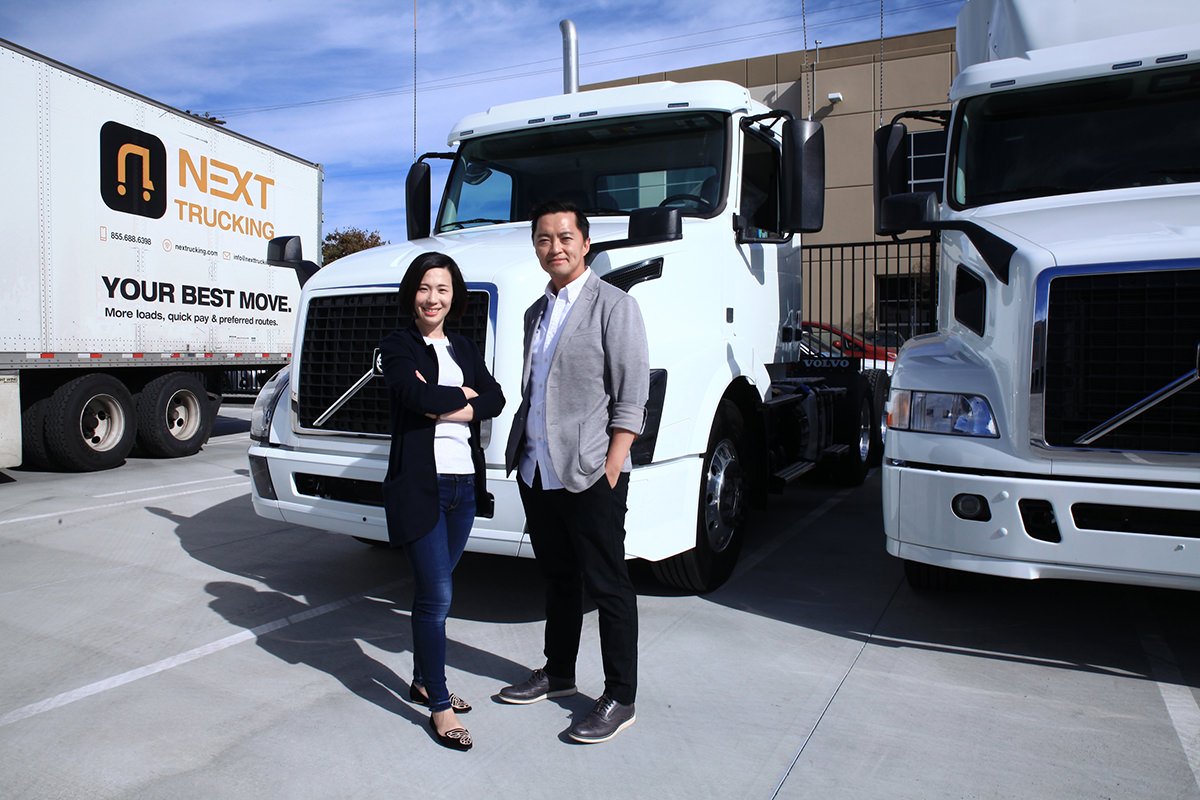
    (Pictured above: Lidia Yan, Co-Founder and CEO and Elton Chung, Co-Founder)

    But we’re not resting on our laurels. The funding will go toward hiring the best in the business. Operations and product development will continue to empower the truckers and create a massive virtual fleet of the highest quality independent carriers. Now we will have more ears listening carefully to all parties involved in the supply chain and more engineers and developers working to find ways to solve the crisis brewing with capacity. Our growing team is set on building the best marketplace platform to mitigate reasons behind truckers walking away from their rigs and younger people not entering the field.

    LAdUxCK

    You can read the entire press release that covers the Series B funding, you’ll find it here.

    If you’re a driver and you’re looking for easy booking, full transparency, earning 15 percent more on average, and so much more sign-up here. It’s the first step in making a difference in your life.

    For the shippers looking for vetted drivers, capacity relief and benefit from the best rates, let us know here.

    While we’ve made great strides to-date, we have a mission. Our driver-centric marketplace will continue to positively impact the transportation industry. Stay tuned. Lots more news to come.