Category: Trucker Life

  • Feeling the Capacity Squeeze? It’s Time to Get Agile!

    Feeling the Capacity Squeeze? It’s Time to Get Agile!

    By empowering people and sparking their entrepreneurial spirit, companies are using organizational agility to create improved results and inspire creative thought amongst their employees.

    For many legacy corporations, the main obstacle to respond quickly to new market trends and disruptive new market entrants are: extensive hierarchic decision-making processes, competing internal initiatives, and silo-based thinking. When the market shifts suddenly, less progressive companies are often left in the dust because there are too many steps and decision-makers involved.

    Mike Richardson, author of “Cracking the Agility Code,” told me the industry is entering “a new era of better, faster, cheaper that is requiring enterprises of all shapes and sizes to pivot to agile.” Mike then explained that agility is “the ability to adapt to rapidly changing circumstances and stay ahead of our competition in meeting customer expectations.”

    This is relevant now more than ever to shippers as it applies to the current driver and capacity shortage in the full truckload market. Shippers are now expected to meet increasingly narrow delivery windows or pay costly “compliance fees” or penalties, which eat heavily into profits. With drivers being picky about where they want to take loads from, many shippers are balancing price and capacity while they compete to get their goods to market.  

    According to the Journal Of Commerce, the US economy has grown at a rate of 2.6 to 3.2 percent growth over the last three quarters, adding yet another layer of complexity to the transportation capacity issue. Shippers of all types need to rethink their Supply Chain Strategy and specifically their distribution schedules, while increasing efficiency and look at making their shipping and receiving processes more efficient.

    “It’s an industry-wide challenge, including with supply chains and shippers,” Mike said, “Enterprise agility is the only competitive advantage which has any permanence these days.”

    But where does a shipper start with getting that kind of visibility into their supply chain? Without a consolidated log of all their calls and shipment statuses, it becomes difficult to find the blind spots where your supply chain might be weakest.

    The first step would be to find a software solution to post and track shipments. Freight tracking software, like the NEXT for Shippers portal, help shippers see exactly where their loads are by the minute through live GPS tracking. Using this technology, shippers can even more efficiently direct truckers at their warehouses, saving time loading and unloading.

    Plus, with a full shipment timeline for each load and comprehensive metrics measured in the platform, it’s easy to go back and see any weak spots in the supply chain. From there, shipping companies can then implement organizational agility practices and adjust their workflows to start moving loads even more efficiently by putting people and inventory in the right place at the right time. If you are tracking a load and see that it is coming to your warehouse in 15 minutes, move to make sure that you have a dock available for that truck to park in and workers available to move the freight where it needs to go.

    Once you figure out how and when loads are moving in and out of the warehouse, your supply chain will be agile enough to easily recalibrate for whatever shifts the market throws at you.

    Mike Richardson is the author of “Cracking the Agility Code.” You can learn more about his work at agilitycode.com.

    Have more questions about agile supply chains? Reach out to Gina on LinkedIn or email her at gina@nexttrucking.com.

  • Logistic Optimization in the Digital Age // Press Round-Up Week of 2/26-3/2

    Logistic Optimization in the Digital Age // Press Round-Up Week of 2/26-3/2

    Many shipping companies today use technology, but most are not getting the most potential out of their electronic devices. New innovations have integrated themselves into the supply chain more than ever before, but it still feels like the industry is just scratching the surface as to what’s possible with digital logistics. So how exactly is tech changing the trucking industry? Here are 5 pieces that look at the possibilities of the internet supply chain.

    Food & Beverage Ecommerce: How Online Shopping Impacts The Supply Chain
    With 16% of adults taking part in the fresh produce ecommerce chain, the online food and beverage supply chain is becoming even more crucial to food retailers’ day to day businesses. This piece at Supply Chain Management Review goes in depth on the best practices for managing a digital produce marketplace and the various considerations to take into account when starting one.

    Why Trucking and Logistics Will Lead the Autonomous Vehicle Revolution
    While autonomous vehicles have been in development for a much longer time in non-commercial vehicles, this piece at Trucks.com goes in-depth as to why trucking is at the forefront of the innovation. The article goes into all the different ways that trucks are experimenting with innovation, and is great further reading for our autonomous trucks post from last week.

    Are Your Trucks Ready for Last-Mile Logistics?
    One of the rising trends to come out of the ecommerce is popularity of last-mile shipping, so preparing your fleet to properly execute this type of delivery can be crucial. Trucking Info takes an in-depth look at what kind of trucking technology and logistic precautions fleets need to start going the final mile.

    Store Fulfillment for E-Commerce Success
    While it is commonly thought that the rise of online stores means the fall of brick and mortar shops, that might not be the case. Logistics Viewpoints examines how physical stores are being repositioned within the new digital supply chain, and the different ways that customers today are feeling about walking into a store in the digital age.

    Tech, not consolidation, will drive container shipping change
    With seven container carrier companies closing over the past two years, now might be the perfect time for overseas shipping to experience a radical technology change. The Journal of Commerce argues that getting these companies to use one neutral blockchain platform now is easier than ever, and could give the industry the shake-up it needs.

  • Tech Talk: How Tesla’s autonomous truck Supercharged the Trucking Industry

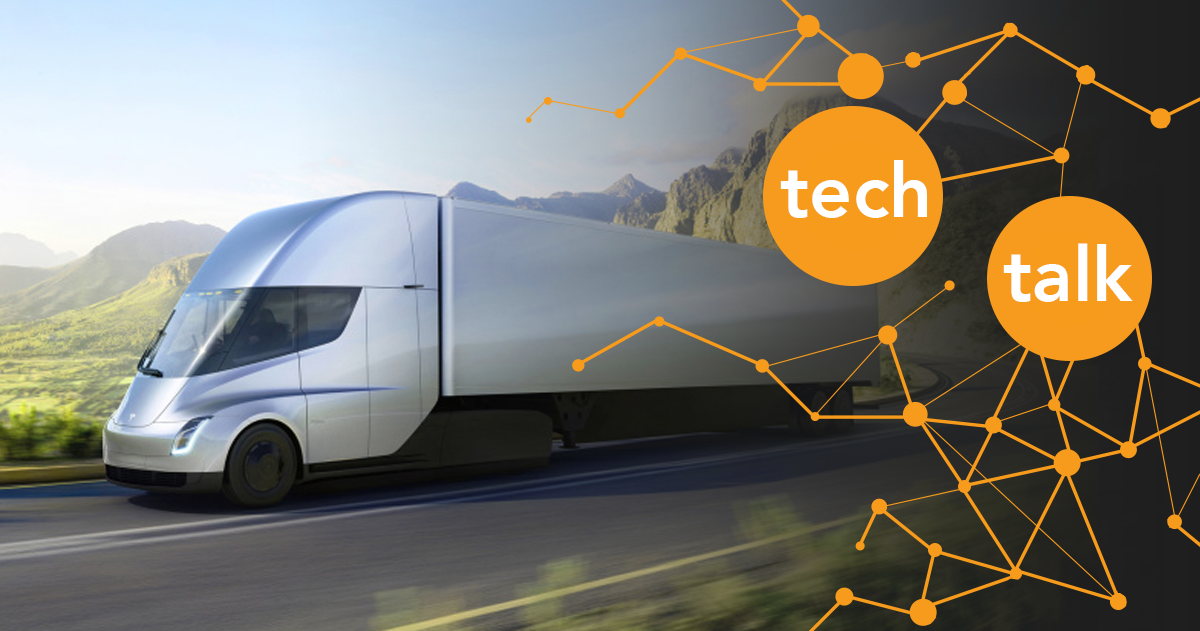
    Tech Talk: How Tesla’s autonomous truck Supercharged the Trucking Industry

    Tech Talk is a series where we examine the latest trends in trucking technology and their potential impacts on the industry at large. In our first set of posts, we look a recent innovation to the industry’s keystone: the truck.

    Since Tesla unveiled their autonomous trucks in November 2017, it seems like there is a new story about autonomous trucks every week. For the first time ever, trucks showed up on the floor at the Consumer Electronics Show (CES) in January 2018, with Peterbilt and TuSimple showcasing their autonomous trucks. Multiple companies like Undelv and Pizza Hut have also taken their autonomous trucks to the streets in public delivery tests.

    The Department of Transportation has also begun getting public input from manufacturers, the public, and truck drivers to determine if they should hasten the deployment of autonomous trucks. While the manufacturers of the trucks are moving ahead into production, the vehicle has caused much discussion of its implications within the trucking industry.

    Many within the trucking industry are not happy with the development of the autonomous trucks. A vocal critic of trucking automation so far has been the Brotherhood of Teamsters. Union head James P. Hoffa has said in an interview with Reuters that he worries that the change is coming too fast and more research should be done on the impact of the people involved, particularly in terms of job security and safety.The Center for Global Policy Solutions has also published a report stating that autonomous trucking could hurt the economy of states that have a high volume of truckers such as West Virginia and Mississippi.

    Autonomous truck manufacturers, on the other hand, purport autonomous trucks as a net positive for the industry. Besides integration possible with current freight-tracking systems, the companies claim that autonomous trucks also provide numerous benefits to shippers. The trucks can automatically calculate the most efficient lanes and routes, saving time on delivery. Additionally, the automated trucks can give truckers some respite on the freeway, where long haul truckers spend most of their days. This would lead to improved trucker health and wellbeing, thus helping to alleviate some driver turnover.

    Tech companies rolling out autonomous trucks also argue that trucker job loss will be minimal. Autonomous trucks will still need drivers to navigate busy city streets and load at docks, and though the trucks can cruise down highways, drivers must be able to take over the rig at a moment’s notice. Even under a platooning, a possible model for autonomous truck fleets where one lead truck sends information to the other trucks that allows them to drive autonomously, there would need to be multiple drivers so the driver in the lead truck can be switched out regularly.

    While these advancements hold lots of different possibilities for shippers and the industry, there is still much work to be done to put the infrastructure in place to get autonomous trucks running. Though Tesla has projected a 2019 release of its electrical truck, it has yet to announce a release date for the truck-specific charging stations that it would have to roll out across the nation. In an industry choking under an already large volume of freight demand that the ATA predicts will increase by 37%, autonomous trucks are being hailed by many tech companies as the solution to the driver shortage.

    Whether or not the systems needed to keep the trucks functioning will be ready in time is yet to be known, and more solid research on automation’s impact on trucking has yet to be published. Nonetheless, we’ll have to sit on cruise control and patiently wait to see what the future holds.


    Next time: We take a closer look at the electricity types powering the new generation of trucks.

  • $21 MILLION IN FUNDING: WE’RE MOVING FULL SPEED AHEAD

    $21 MILLION IN FUNDING: WE’RE MOVING FULL SPEED AHEAD

    NEXT Trucking is only one month into 2018 and we already have great news. Today, we announced $21 million series B round of funding led by Sequoia Capital. As well, the VC’s partner, Omar Hamoui is joining our Board of Directors. Omar’s mobile ad platform AdMob was sold to Google in 2009 for $750 million, and Sequoia Capital was one of the first investors in the platform.

    We’re so proud of all we’ve been able to do in only two years. We’re a scrappy team. Even so, we have tripled our revenue year over year. And, our retention rates, on both sides of the marketplace, are through the roof.


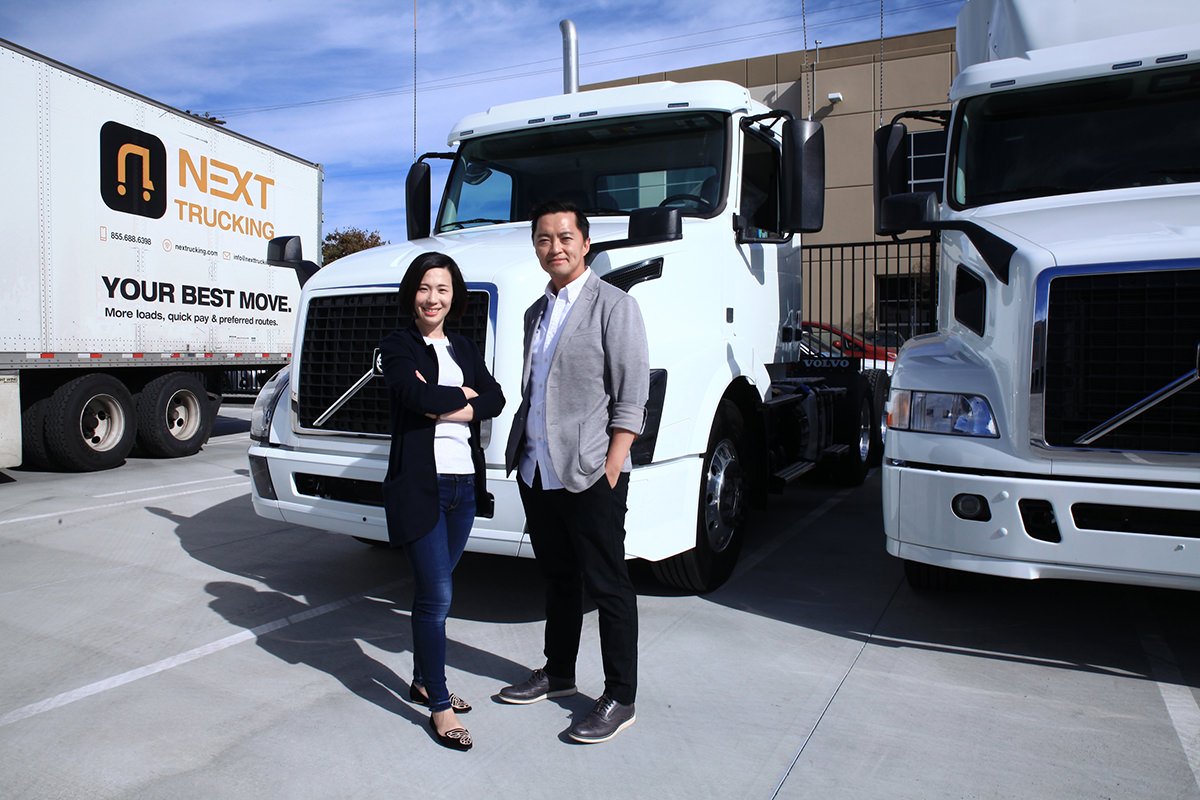
    (Pictured above: Lidia Yan, Co-Founder and CEO and Elton Chung, Co-Founder)

    But we’re not resting on our laurels. The funding will go toward hiring the best in the business. Operations and product development will continue to empower the truckers and create a massive virtual fleet of the highest quality independent carriers. Now we will have more ears listening carefully to all parties involved in the supply chain and more engineers and developers working to find ways to solve the crisis brewing with capacity. Our growing team is set on building the best marketplace platform to mitigate reasons behind truckers walking away from their rigs and younger people not entering the field.

    LAdUxCK

    You can read the entire press release that covers the Series B funding, you’ll find it here.

    If you’re a driver and you’re looking for easy booking, full transparency, earning 15 percent more on average, and so much more sign-up here. It’s the first step in making a difference in your life.

    For the shippers looking for vetted drivers, capacity relief and benefit from the best rates, let us know here.

    While we’ve made great strides to-date, we have a mission. Our driver-centric marketplace will continue to positively impact the transportation industry. Stay tuned. Lots more news to come.